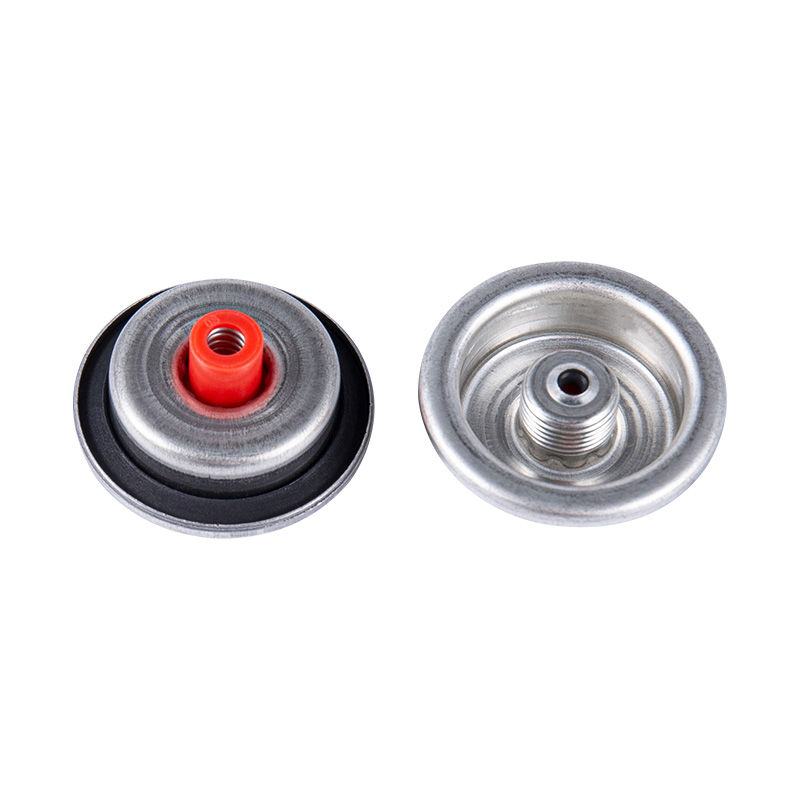
Of all the changes in aerosol packaging, the move toward bag-on-valve (BOV) systems stands out. A flexible pouch holds the product; compressed air fills the space around it. Open the aerosol can valve and the air does the work, pushing contents out while staying completely separate from the formula.
That separation turns out to matter quite a lot in practice. A few reasons the format has taken hold:
That cleaner chemistry comes with real engineering demands. Compressed-air valves work within a narrower pressure band, and the orifice has to be machined to match — tolerances that used to sit around ±0.06 mm on hydrocarbon packs are now expected to halve. The valve cup seal, long treated as a detail, has become something engineers actually argue about.

The spring is the part nobody notices — small, hidden, never mentioned on the label. But press a nozzle that feels stiff, or find a can leaking in your bag, and the spring is usually where the explanation starts. It sets actuation feel, controls how cleanly the valve reseats, and keeps the product contained for however long it sits on a shelf.
Cycle count only tells you so much. A spring that holds up fine in water may crack well before its rated life when exposed to organic acids, high-salt formulas, or reactive solvents. The failure mode to watch is stress corrosion cracking — corrosive media and mechanical stress working together to split the wire from the inside out.
Aerosol can valves divide broadly into two types. Continuous-spray valves deliver product for as long as the button stays down. Metered-dose valves — MDVs — release a fixed, reproducible quantity each time, then stop. That functional difference propagates through every stage of production.
| Production parameter | Continuous-spray valve | Metered-dose valve |
| Orifice tolerance | ±0.05 – 0.10 mm, standard machining | ±0.01 – 0.03 mm; laser drilling widely used |
| Metering chamber | Not present | Precision-moulded cavity; volume held to ±2–5% |
| Assembly environment | Standard production floor | ISO class 7–8 cleanroom for pharmaceutical MDVs |
| Leak testing | Go/no-go pressure hold per batch | 100% helium or air-decay test per individual unit |
| Elastomer grade | NBR or EPDM, general specification | Pharmaceutical-grade EPDM or TPE with extractables profiling |
| Line output rate | 300 – 600 valves per minute | 100 – 250 valves per minute |
Continuous-spray lines are built around throughput and dimensional consistency. Vision systems check stem geometry and housing dimensions at speed; crimp quality gets sampled regularly to ensure filling-line pressures won't cause failures downstream. It's efficient, proven manufacturing.
MDV production operates in a different register. Four things stand out:
Propellant system, spring alloy, production regime — three variables that look independent but in practice shape each other. Understanding how they interact is increasingly central to getting aerosol can valve specification right, regardless of which category a product sits in.


+86-18238070562

+86-579-85791578


No.28, Tongyi Road, Yiting town, Yiwu 322000 - Zhejiang Province, P.R.C.
Copyright © Bluefire Industries Limited All Rights Reserved. Two-Piece Aerosol Can


 English
 عربى
عربى Español